Leadership / Product / Delivery
I lead complex enterprise work and build products of my own.
Executive summary
Enterprise leadership
I’m Director of Product Management at Umbrage, part of Bain & Company. I lead complex, high-stakes engagements across regulated utilities, financial services and enterprise software, aligning stakeholders and teams across product, design, engineering and QA. My adoption work earned three follow-on contracts.
Founder and developer
I’m a co-founder and sole developer of Career PCS. More than 1,600 applicants have used the platform to pursue civilian internships and career training.
Agentic development
I built and launched The Small But Mighty, a K–5 curriculum platform, by directing AI agents. I set product direction and acceptance criteria, with independent review before I accept changes.
Leadership foundations
My career began in the infantry.
U.S. Army · Infantry Officer
October 2010–October 2022
For twelve years, I led soldiers who had to act on the decisions I made. A plan had to make the objective clear, account for the resources available and leave people room to respond when circumstances changed.
My responsibility continued after the plan was made. I had to coordinate the work, make decisions as conditions evolved and remain accountable for the people and the outcome.
Before I left the Army, I started building a technical foundation for what came next. Through the Army Career Skills Program, I attended a coding bootcamp at UNC while I was still serving.
Read my Army experienceData services and delivery
Into tech through product management.
ComboCurve · Data Product Manager, Data Services
January–October 2023
At ComboCurve, the connection between a customer’s experience and the software behind it became my product responsibility. I established the company’s first data-services product strategy and roadmap for a B2B energy forecasting platform.
I led integration strategy across APIs, data pipelines and synchronization, doubling API coverage. I also rebuilt the delivery lifecycle, tripling development velocity.
With Career PCS, I became responsible for building the software as well as deciding what it should do.
Read my ComboCurve experienceFounder and developer
Then I started building.
Career PCS · Technical Co-Founder, Product Lead & Lead Developer
April 2024–Present
Employers using Career PCS






As a co-founder and sole developer of Career PCS, I became responsible for both the product decisions and the code. Vibe coding gave me a way to carry those decisions into a platform people could use.
Career PCS serves people facing a transition I know personally. It helps military service members find civilian internships and career training before leaving the military. Employers use it to manage applications, track required approvals and meet program requirements.
I organized discovery around where someone could realistically train. That could mean near a military installation, in a destination state or remotely. Geographic relevance takes priority in location results, with local and remote opportunities clearly distinguished.
Leaving the military brings enough uncertainty. I built application submission and tracking to give service members a clear record of what they’ve applied for and whether their application reached the employer.
More than 1,600 applicants have pursued opportunities through Career PCS. Google Search clicks grew 175% across comparable three-month periods.
Owning the product and its implementation brought those decisions close together. My enterprise work extends that responsibility across larger teams and organizational boundaries.
Search Console: 6,785 clicks, July 17–October 16, versus 2,466, April 16–July 16, 2026.
Explore the Career PCS opportunity mapComplex enterprise delivery
Building at enterprise scale.
Umbrage, part of Bain & Company
Senior Product Manager · January–December 2025
Director of Product Management · December 2025–Present
Alongside my founder work, I lead complex, high-stakes enterprise engagements at Umbrage. I align stakeholders and bring product, design, engineering and QA together around shared direction, while priorities shift and dependencies change.
For an enterprise software organization, I led a product-management team designing an operating model informed by staff research and a tooling audit. We established governance, decision rights, an OKR hierarchy and a reporting framework leadership uses.
I personally drove a 1,700-member workspace consolidation through a single-weekend cutover, retiring a competing tool for the teams in scope. I also built the onboarding, training and office-hours support behind adoption. That adoption work earned three follow-on contracts.
The responsibility included the technical transition and the organizational support to make the new model usable. Alongside that enterprise work, I’ve been building a more deliberate process for directing AI.
Read my enterprise product experienceDeliberate agentic development
The workflow became part of the product.
The Small But Mighty · Creator and Editor
April 2026–Present
I built and launched The Small But Mighty, a K–5 curriculum subscription platform, by directing AI agents through investigation, planning, implementation, testing and review. Parents can discover, preview and download curriculum on the working platform.
I set the product direction and acceptance criteria. Agents investigate and plan the work, then carry bounded implementation assignments. Separate reviewers challenge the changes. Findings go back through repair and review before I decide what to accept.
I decide what families need, what to prioritize, how the pieces fit together and whether the result is ready. The agents carry work through the process. I remain responsible for directing it and judging the result.
I extended the same approach into the Content Factory, where agents carry curriculum through drafting, source verification and editorial review, with human approval before publication.
As more work moves across separate agents and sessions, I need to see where it stands and where my attention is needed. I built W.A.T.C.H. to keep that work in view.
Explore The Small But MightyOversight in practice
I needed to see the work happening.
Project W.A.T.C.H.
Window on Agents, Tools, Changes and Hand-offs
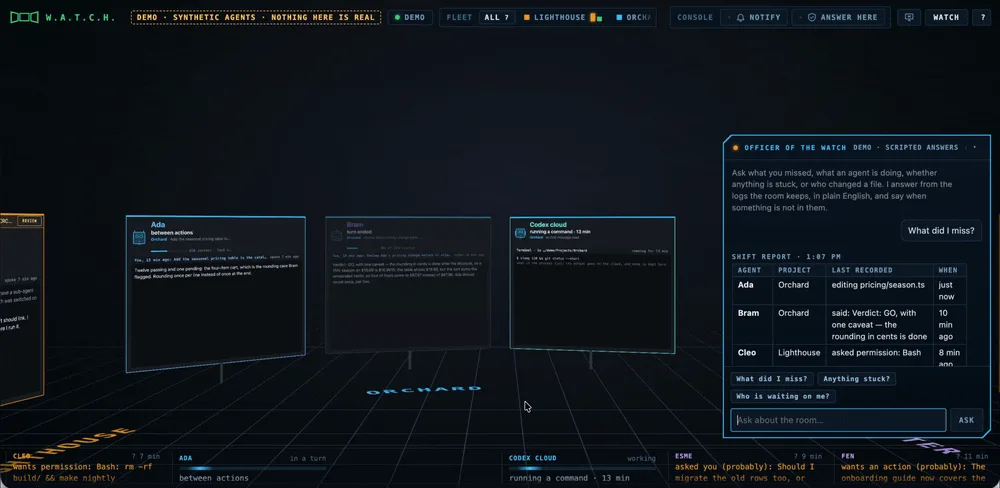
Several coding agents can be carrying different parts of a build in separate terminals and conversations. By the time I review a transcript, a decision I would have questioned may already be several changes behind me.
I built W.A.T.C.H. as a live room of monitors, one per agent, bringing activity from Claude Code, Codex and Cursor into one place. I can scan the room, see who needs input and step closer to inspect an agent’s messages, commands and recorded changes.
The design centers on where my attention is needed. It surfaces requests waiting on me and keeps each agent’s assignment in view. It also makes gaps in the available records explicit, so I can judge what the tool actually establishes.
I use it daily to stay involved while agents carry the work. I can follow decisions as they happen instead of reconstructing them afterwards.
Explore W.A.T.C.H. on GitHubProduct leader / Founder / Agentic developer
Andrew Towers
My work connects people, product judgment and technical execution. From aligning stakeholders to leading delivery and building with AI, I stay accountable for turning direction into something people can use.
Replay the storyLet’s talk about the work.